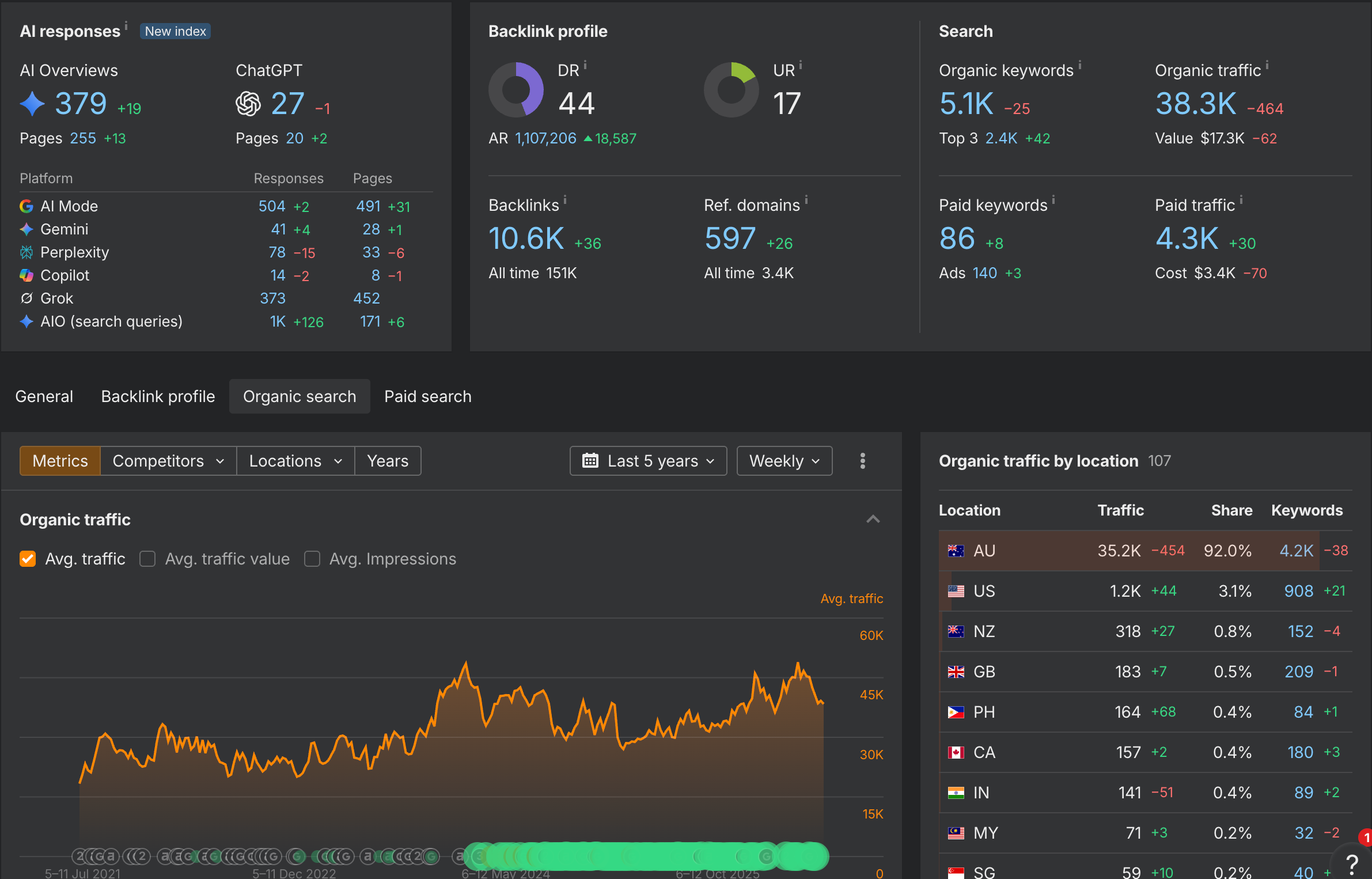
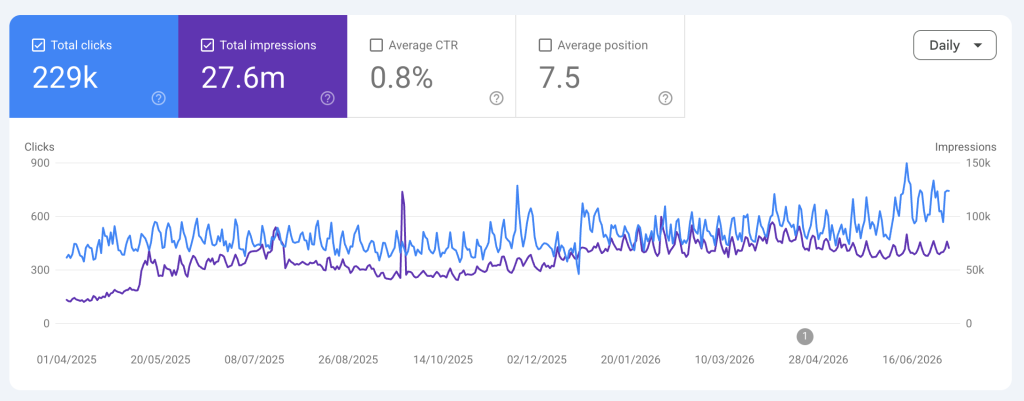
Client snapshot
EzyDog Australia is the home market for the EzyDog brand, selling premium dog harnesses, leads, life jackets and outdoor gear direct-to-consumer via Shopify. The Australian pet products market is mature and competitive, with strong local and international players competing for the same high-intent search terms. EzyDog AU is a mid-to-high-ticket store where organic traffic has a direct and measurable revenue impact.
The challenge
When the project started, EzyDog AU was not ranking for any of their major category keywords. The organic channel was effectively invisible for the terms that matter commercially. The team could see the traffic potential was there but had no clear picture of why the site was not showing up. They were relying too heavily on paid channels and had no repeatable organic growth engine in place.
The diagnosis
- Paragraph tags were being used in place of H2 and H3 tags across all major category pages. The heading hierarchy was completely broken from a semantic HTML perspective, signalling to crawlers that there was no content structure on these pages.
- H1 tags on collection pages were either generic store-level headings or duplicated across multiple pages. No page had a primary keyword targeted in its H1.
- Meta titles on category pages were auto-generated from the Shopify theme and followed a pattern of
[Collection Name] - EzyDog, with no keyword intent, no value proposition, and character counts well under the 60-character optimal range. - Meta descriptions were either missing entirely or populated with the first sentence of a short collection description that had not been written for search intent.
- Internal linking between related collection pages and product pages was minimal. Link equity was pooling at the homepage and not flowing to the commercial pages that needed ranking signals.
- Page speed on mobile was poor due to unoptimised images and render-blocking JavaScript in the theme.
- There was no structured tracking in place for organic channel revenue isolation. Attribution between organic, direct and email was mixed and unreliable.
What we built
- Conducted keyword research for every major product category. Assigned a single primary keyword cluster and supporting secondary keywords to each collection page.
- Rebuilt the heading hierarchy on all category pages: correct H1 with primary keyword, H2 subheadings using semantic variations, paragraph tags used only for body copy.
- Rewrote all category page meta titles and meta descriptions to target primary keywords, match search intent, and include a conversion-oriented value signal.
- Wrote long-form collection page content blocks for each major category, structured around topical authority: product education, buying guides, FAQs and internal links to related collections.
- Built a systematic internal linking structure: category-to-category links based on topical relevance and product-to-collection contextual links on all major product pages.
- Ran a CRO audit on collection and product page templates and implemented changes: trust badge placement, above-the-fold layout restructure, product image optimisation and page speed improvements.
- Implemented cross-sell modules on product pages tied to complementary SKUs. Tested and refined AOV-lifting mechanics.
- Set up GA4 with Looker Studio reporting dashboards for monthly performance review. Implemented server-side tracking for key conversion events to maintain data accuracy.
- After organic growth plateaued at the top of existing category rankings, conducted keyword expansion research to identify adjacent intent clusters within the same product range, then implemented content and page optimisations for the expanded keyword set.
- Configured AI visibility tracking: monitoring organic performance from ChatGPT, Gemini and Perplexity referrals via GA4 source/medium segmentation.
The results
| Metric | Before | After | Period |
|---|---|---|---|
| Major category keyword rankings | Not ranking | #1 for all major categories | Within first months |
| Organic sales | Baseline | +18% | Month 1 post-optimisation |
| BFCM organic revenue | — | Highest organic revenue of the year | Year 1 BFCM |
| AI platform conversion rate | Not tracked | 12%+ | Ongoing |
| Month-over-month organic revenue | Flat | Growing each month | Post-expansion phase |
The business impact
The 18% organic sales increase in the first month was a direct product of fixing fundamentals that should never have been broken. Paragraph tags masquerading as headings, generic meta titles, and no keyword intent on category pages are not nuanced SEO problems. They are basic structural failures that prevented a strong brand from being visible in searches it had every right to rank for. Fixing them produced immediate results.
What came after is the more interesting story. When organic growth plateaued after EzyDog AU reached the top positions for its core categories, the instinct for most teams would be to declare victory. Instead, we researched adjacent keyword clusters that matched the existing product range but captured demand the site was not yet addressing. That expansion phase restarted the growth curve. Now EzyDog AU is also generating measurable revenue from AI platforms, with a conversion rate above 12% from ChatGPT, Gemini and Perplexity referrals. A 12% conversion rate from any source in ecommerce is exceptional, and it reflects how the brand is being positioned in AI-generated responses.