Client snapshot
EzyDog Europe operates across Germany, Spain, France, Italy and the Netherlands, selling premium dog accessories across five distinct country markets. The European operation had previously run on separate country-level TLDs before being consolidated. This is one of the most technically complex ecommerce migration scenarios that exists: multiple markets, multiple languages, multiple URL structures, and a platform change layered on top of all of it.
The challenge
The European sites were running on BigCommerce across country-specific TLD domains. The technology was limiting the team's ability to manage the storefronts efficiently, and Shopify was the target platform. The problem was that the existing analytics configuration was broken before the migration even started, there was no clean URL architecture to migrate from, and the sheer complexity of managing five market-language combinations meant every decision had compounding downstream effects.
The diagnosis
- The existing GA4 configuration on the BigCommerce setup was fundamentally broken. Cross-domain tracking between the country TLDs was not configured, meaning user journeys across markets were being split into separate sessions. Revenue attribution was wrong across every market.
- The BigCommerce URL structure used auto-generated parameter-based URLs for filtered product views. These had been crawled and indexed at scale, creating thousands of low-value indexed pages consuming crawl budget.
- No canonical tag strategy existed across the five country sites. Equivalent product pages in different markets were being treated as independent competing pages rather than localised variants.
- Hreflang was either missing entirely or misconfigured on the existing sites. There was no systematic signalling to Google about which page to serve to which country/language audience.
- The robots.txt files across the country sites were inconsistent. Some were blocking pages that should have been indexed. Others were allowing indexation of pages that should have been blocked.
- When we began the Shopify migration, the URL structure needed to change to support proper multi-market management. We changed the site URL architecture twice during the project, each change generating a new wave of 404 errors that required a new redirect layer.
- The scale of 404 errors after initial migration was significant. Crawl log analysis showed crawl budget being consumed by broken URLs that had accumulated from the previous platform change and from the mid-project URL restructures.
- Tracking configuration had to be rebuilt twice during the project due to the URL structure changes. Each rebuild required re-validating the entire event and conversion setup against both the Shopify data layer and GA4.
What we built
- Audited all indexed URLs across the five BigCommerce country sites. Categorised every URL: keep with redirect, redirect to equivalent Shopify URL, or allow to 404 with no redirect (thin/duplicate pages).
- Built a full URL mapping matrix across all five markets: BigCommerce URL to Shopify URL, with market and language noted for each row.
- Designed the final Shopify URL architecture with multi-market structure as a hard requirement before any development work began. URL structure decisions were made once and documented before implementation.
- Implemented 301 redirects across all five markets using Shopify’s redirect management and supplementary redirect apps where volume exceeded Shopify’s native limits.
- Conducted a crawl budget audit post-migration. Identified all remaining 404 sources: stale external links, incorrect internal links and sitemap entries pointing to old URLs. Resolved each category systematically.
- Implemented hreflang tags across all five country/language combinations: de, es, fr, it, nl with correct x-default fallback. Validated using Google Search Console’s International Targeting report and third-party hreflang validators.
- Rebuilt robots.txt files for the new Shopify structure on each market subdirectory or domain. Blocked parameter-generated URLs and internal search pages while keeping all commercial pages accessible.
- Rebuilt GA4 from scratch on the new Shopify architecture. Configured cross-domain tracking where applicable, set up currency-correct revenue tracking per market, and validated against Shopify native revenue data.
- Ran full on-page SEO optimisation for each market’s major category pages: localised keyword research per market, translated and localised meta titles, meta descriptions, H1s and category content.
The results
| Metric | Before | After | Period |
|---|---|---|---|
| Platform | BigCommerce (multi-TLD) | Shopify (unified) | Migration complete |
| Markets live on new platform | 0 of 5 | 5 of 5 | Post-migration |
| Critical 404 errors | Hundreds of crawl-budget-wasting 404s | Resolved | Post-audit |
| Hreflang configuration | Missing or broken | Correctly configured for all 5 markets | Post-implementation |
| GA4 tracking reliability | Broken cross-domain attribution | Rebuilt and validated | Post-rebuild |
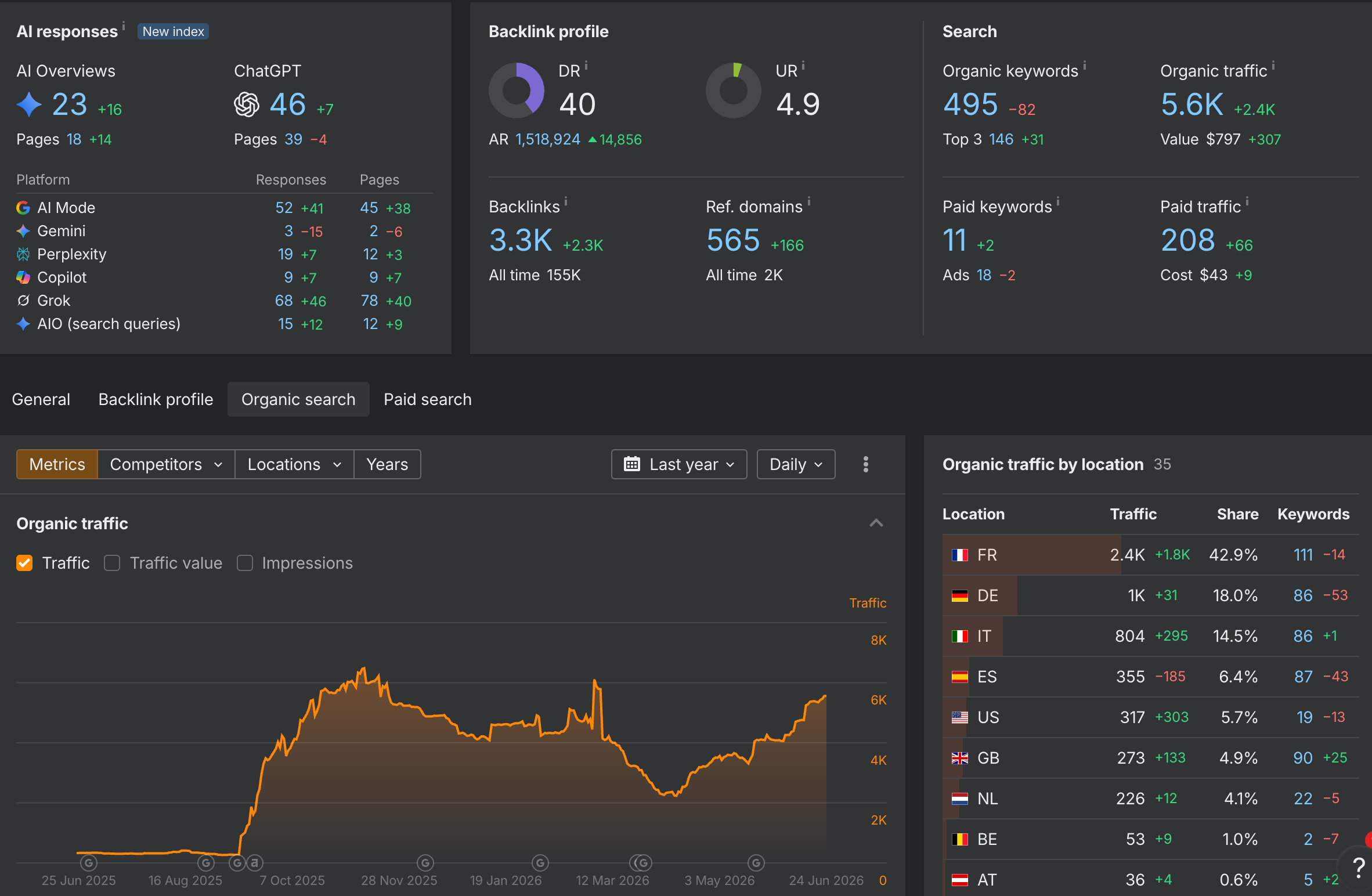
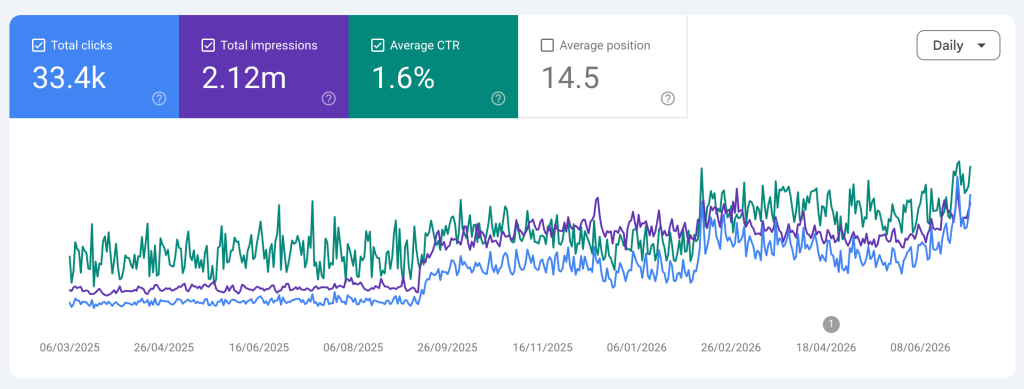
| Organic sales | Disrupted by migration | Restored and generating across EU markets | Post-stabilisation |
The business impact
The honest version of this case study is that EzyDog EU was one of the hardest projects we have worked on. The combination of a platform migration, five distinct markets, two mid-project URL architecture changes, and a pre-existing broken analytics configuration meant that every step forward revealed a new problem to resolve. Changing the URL structure twice during live migration is not something that appears in clean case studies. It happened because the correct long-term architecture required it, and we worked through the resulting 404 waves rather than leaving the structure compromised.
What EzyDog EU now has is a stable, correctly configured multi-market Shopify operation with reliable tracking, clean crawlability, and properly implemented hreflang across all five country markets. For a brand operating across Germany, Spain, France, Italy and the Netherlands, that infrastructure is the prerequisite for any sustainable organic growth. Getting to that foundation required doing the hard work twice when circumstances demanded it.